The Short Answer
A self-managed HOA is one where the volunteer board handles all operations without hiring a professional management company. Self-management works best for smaller communities with engaged boards — and with the right software behind them, it can deliver results that rival full-service management at a fraction of the cost.
If you're exploring self-management, there are two paths boards often don't know about: doing it entirely on your own with professional-grade software, or purchasing a set block of management hours from a company like Association Property Managers to handle the tasks that take the most time. Both approaches are explained below.
The Benefits of Self-Management
**Cost Savings:** Professional HOA management can cost $10,000–$36,000+ per year for a mid-sized community. Self-management — supported by the right platform — can reduce that cost by 60–80%.
**Direct Control:** Board members make decisions without a management company intermediary. Response times are faster. Communication is more personal. You know exactly what's happening in your community.
**Community Connection:** Self-managed boards tend to have stronger relationships with homeowners. Decisions get made by people who live there, not a corporate property manager three states away.
**Transparency by Default:** When you run your own operations, you see every transaction, every vendor payment, every communication — because you're the one initiating them. Nothing happens off-screen.
The Challenges of Self-Management
**Time Commitment:** Dues collection, vendor coordination, violations management, financial reporting, meeting prep, architectural requests — these tasks compound quickly. A community of 80 units can easily require 15–20 board hours per month of administrative work.
**Financial Complexity:** HOA accounting isn't the same as personal finance. Fund accounting, reserve vs. operating segregation, delinquency tracking, and year-end reporting all require discipline. Errors create real legal and financial liability.
**Consistency at Turnover:** Volunteer boards change. When a key board member leaves — often the one who built the spreadsheets and managed the vendor calls — institutional knowledge walks out with them. Communities without centralized software suffer most when this happens.
**Vendor Accountability:** Without professional vendor oversight tools, self-managed HOAs often have no way to verify that contracted work was actually completed, or that vendors showed up for the hours they billed.
When Self-Management Makes Sense
- Your community has fewer than 100 units
- Your board has two or more members with consistent time availability
- Your community's common-area maintenance needs are relatively predictable
- You want full control over vendor selection, dues rates, and communications
- You're willing to use professional HOA software rather than spreadsheets and email
The Flex Model: Purchase a Set Number of Management Hours
One option most boards never hear about: instead of choosing between full self-management or full-service management, you can purchase a defined block of management hours from Association Property Managers — and use them for exactly what you need.
**How it works:** Your board continues to run the community day-to-day. You purchase a set number of monthly management hours — 5, 10, or 20 hours per month — and APM staff handles the tasks you designate. Common examples include:
- Monthly financial reconciliation and bank statement review
- Delinquency follow-up calls and letters
- Vendor invoice processing and payment
- Homeowner dispute mediation
- Annual meeting preparation and facilitation
- Reserve study interpretation and budget planning
**Why it works:** This model gives self-managed communities access to professional expertise without paying for a full management contract. The board stays in control. APM fills in the gaps. And because all activity runs through the HOA Alchemy platform, your board sees every action in real time.
**Who it's right for:** Communities that handle their own vendor coordination and homeowner communications well, but need professional backup for financial management, legal compliance, or occasional complex situations.
Contact Association Property Managers at billing@apmhoa.com to ask about flex-hour packages for your community.
How the HOA Alchemy Platform Changes Self-Management
Self-management has historically meant spreadsheets, email threads, and an accounting system that nobody on the board fully understands. That was the old model. The HOA Alchemy platform — built by Association Property Managers for community associations — changes all of that.
Here's how the platform addresses the four biggest pain points for self-managed boards:
Banking: Your Community's Finances, Live
HOA Alchemy connects directly to your association's bank accounts. Instead of waiting for a monthly statement or asking your treasurer to export a spreadsheet, every board member sees live bank balances, pending transactions, and account activity — updated in real time. No more end-of-month surprises. No more "where did that money go?" at board meetings.
Your operating and reserve accounts are displayed separately, with clear transaction-level detail. The board can see every deposit, every vendor payment, and every transfer the moment it happens.
Receivables: Dues Collection Without the Awkward Conversations
Collecting dues from your neighbors is the task most self-managed boards dread. HOA Alchemy automates the entire receivables workflow: dues notices are generated and sent automatically, payment portals accept ACH and credit card payments, late notices go out on schedule, and delinquency status is visible to the board at all times.
When a homeowner calls to say they paid, your board can pull up their account history in under 30 seconds — without calling a management company or digging through bank records.
Payables: Every Vendor Invoice Tracked and Approved
For self-managed HOAs, paying vendors correctly and on time — with proper documentation — is one of the most time-consuming administrative tasks. HOA Alchemy streamlines the entire payables workflow: vendors submit invoices through the platform, the board approves payments from a mobile device, and every payment is automatically logged against the correct budget line.
You always know what you owe, what you've paid, and whether any invoice is pending approval. This alone eliminates the most common financial gaps in self-managed communities.
Community Engagement: One Platform for Every Conversation
Homeowners send emails, texts, voicemails, and letters — often about the same issue — to different board members. HOA Alchemy unifies all of that into one message center. Every homeowner inquiry is logged, assigned, and tracked through resolution. Board members can respond from the platform. No resident is left wondering if their message was seen.
The platform also handles mass communications (meeting notices, policy updates, emergency alerts) with delivery confirmation — so your board knows homeowners received the message, not just that you sent it.
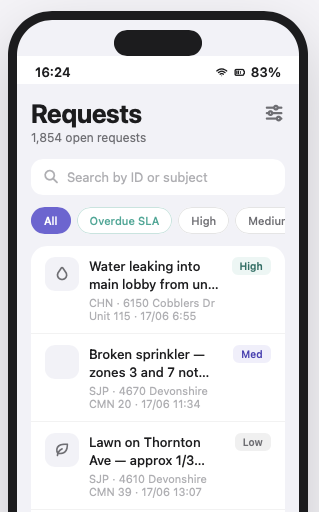
The HOA Alchemy app puts every open community request in one place — residents submit issues, track priority, and get updates without ever calling the board directly.
Frequently Asked Questions
Is self-management legal in Michigan and California?
Yes. Self-management is legal in both Michigan and California. The board is still obligated to comply with the Michigan Nonprofit Corporation Act (or the Michigan Condominium Act for condo associations), or California's Davis-Stirling Common Interest Development Act. Using professional HOA software helps boards stay compliant with required financial reporting and meeting notice obligations.
What software do self-managed HOAs use?
The best self-managed HOA communities use platforms that combine banking integration, dues collection, vendor payment management, and homeowner communications in one system. The HOA Alchemy platform was purpose-built for community associations and is available to both APM-managed communities and self-managed boards seeking professional tools.
How do we handle things we don't have time for?
Association Property Managers offers flex-hour management packages for self-managed communities. Instead of transitioning to full-service management, you purchase a set number of monthly hours — and APM handles exactly the tasks you specify. Many self-managed boards use this for financial oversight, vendor payment processing, or annual meeting support.
At what point should a self-managed HOA consider full-service management?
Most communities reach the transition point when: the community grows past 75–100 units, board turnover creates operational gaps, vendor issues start requiring more than occasional oversight, or homeowner complaints about response times increase. Association Property Managers offers a free consultation to assess your specific situation.
Ready to work with Association Property Managers?
Get a free, itemized proposal for your community — delivered within 3 business days.
Request a Free Proposal