The Short Answer
HOA community portal software in 2026 ranges from basic websites with document libraries to comprehensive management platforms with accounting, payment processing, and maintenance request tracking. The right choice depends on whether you're self-managing or working with a professional management company, and what your homeowners actually need.
The Evolution of HOA Community Portals
A decade ago, most HOA communities managed their online presence with a basic website — a place to post documents and meeting announcements. Today, HOA community portal software has evolved into comprehensive management platforms that integrate accounting, payment processing, maintenance request tracking, homeowner communications, violation management, and document storage.
For homeowners, the portal is often their primary point of interaction with the association between meetings. A well-designed portal reduces phone calls to management, enables 24/7 access to account information, and creates a documented record of communications and requests. A poorly designed portal — or no portal at all — creates frustration and drives homeowners to other channels.
For boards and management companies, portal software that integrates with accounting systems eliminates duplicate data entry, reduces errors, and enables real-time financial reporting. Boards that can pull up the community's current financial position on a tablet during a meeting are better equipped to make decisions than those waiting for paper statements.
Key Features to Look for in 2026
When evaluating HOA portal software, look for the following features:
**Online assessment payment.** This is the most-used feature for most homeowners. The portal should accept ACH (bank transfer) payments without a transaction fee and credit/debit card payments with clearly disclosed fees. Auto-pay enrollment should be easy to set up and modify.
**Maintenance request submission and tracking.** Homeowners should be able to submit maintenance requests, upload photos, and receive updates on the status of their requests. The management team should be able to assign requests to vendors, track progress, and close requests with documented resolution.
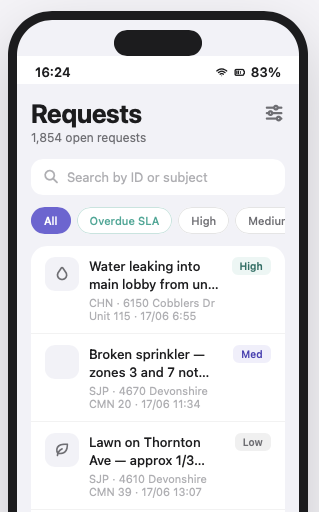
HOA Alchemy — every maintenance request in one queue. Residents submit with photos, track status, and get notified on resolution. No calls to the board required.
**Document library.** Governing documents (CC&Rs, bylaws, rules), meeting minutes, financial reports, and community policies should be easily searchable and accessible to homeowners 24/7.
**Financial reporting for boards.** Board members should have access to real-time financial reports — income statement, balance sheet, accounts receivable aging, reserve fund balance — without waiting for monthly statements. Role-based access controls should ensure that detailed financial data is visible to board members but not all homeowners.
**Homeowner communication tools.** The platform should support email broadcasts to all homeowners, targeted messages to specific homeowners, and emergency notification capabilities.
**Violation management.** For management companies, integrated violation tracking — including notice generation, hearing scheduling, and fine assessment — reduces administrative burden and ensures consistent, documented enforcement.
What to Avoid
When evaluating HOA portal software, watch for these red flags:
**Payment processing fees hidden in small print.** Some platforms advertise "free" software but generate revenue through payment processing fees. Understand the full fee structure — including per-transaction fees for ACH and credit card payments — before committing.
**Poor mobile experience.** Most homeowners will access the portal on a mobile device. A platform that looks good on a desktop but is unusable on a phone will be underused.
**No integration with accounting software.** If the portal's payment processing doesn't integrate with the accounting system, someone has to manually enter each payment — creating data entry work and potential errors.
**Vendor lock-in.** Some platforms make it difficult to export your data or transition to a different system. Ask specifically about data portability and export capabilities before signing a multi-year contract.
Association Property Managers uses professional-grade portal software for all communities we manage — in both Michigan and the Bay Area — providing homeowners with the self-service tools they expect and boards with the real-time financial visibility they need.
Frequently Asked Questions
What does HOA portal software typically cost?
For management companies, portal software is typically included in the management fee. For self-managed communities, standalone HOA portal software typically costs $1 to $5 per unit per month, depending on the platform and feature set. Some platforms have minimum monthly fees that make them less economical for very small communities.
Can a small self-managed HOA afford portal software?
Yes. Several platforms offer self-managed community plans at low per-unit costs. For a 30-unit community paying $3 per unit per month, the total cost is $90 per month — a reasonable expense for the operational efficiency it provides.
How do we get homeowners to actually use the portal?
Adoption is the biggest challenge with HOA portal software. Best practices for driving adoption include: actively promoting the portal in the transition communication; making online payment the default (make it easy, not mandatory); requiring maintenance requests to be submitted through the portal (not by text to a board member's personal phone); and using the portal for all community communications rather than maintaining parallel paper processes.
HOA Alchemy: Built for HOA Communities, Not Adapted From Generic Software
Association Property Managers built the HOA Alchemy platform specifically for community associations -- not adapted from generic property management software. Every feature addresses how HOA boards actually operate and what Bay Area and Michigan homeowners actually expect.
HOA Alchemy delivers capabilities that no other management platform in the region offers: live and historical vendor GPS tracking that verifies service delivery, smart irrigation remote control that cuts Bay Area water bills by 25 to 35 percent, remote property sensors that detect leaks and temperature issues in real time, smart pool gate and common area access control managed remotely, and a live bank dashboard that gives every board member real-time financial visibility.
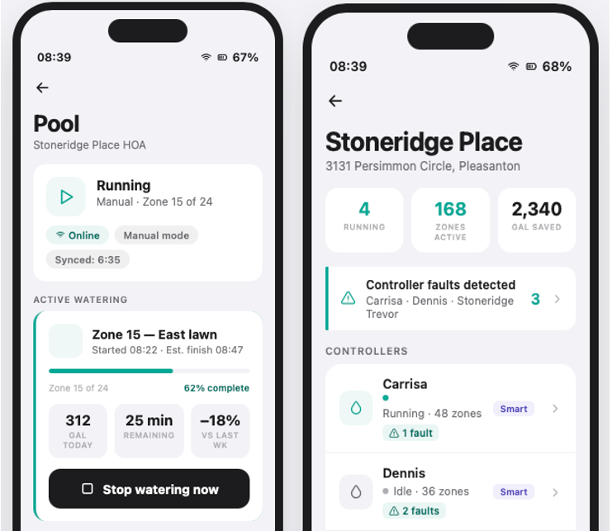
HOA Alchemy smart irrigation controls — real zones, real properties, managed remotely. This is the actual platform APM uses to cut Bay Area water bills 25–35%.
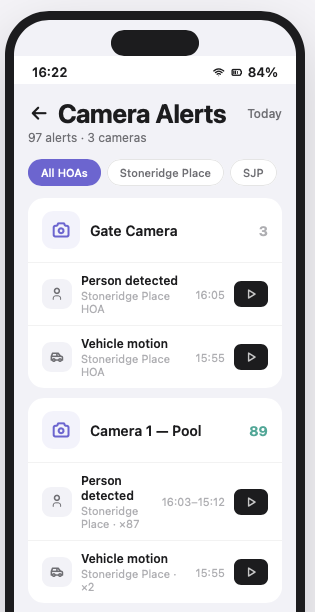
HOA Alchemy camera alerts — gate and pool cameras, person and vehicle detection, all surfaced in a single app. One platform instead of five separate vendor logins.
These are not bolt-on features -- they are integrated into a single platform that APM operates on behalf of every community we manage. Boards do not need to manage the technology themselves; APM monitors and acts on alerts automatically.
See HOA Alchemy in Action
Contact Association Property Managers at billing@apmhoa.com to request a proposal and a platform demonstration for your community. We serve communities throughout Dublin, Pleasanton, San Ramon, Fremont, Newark, and the broader East Bay, as well as Michigan communities in the Lansing area.
Ready to work with Association Property Managers?
Get a free, itemized proposal for your community — delivered within 3 business days.
Request a Free Proposal