Quick Answer
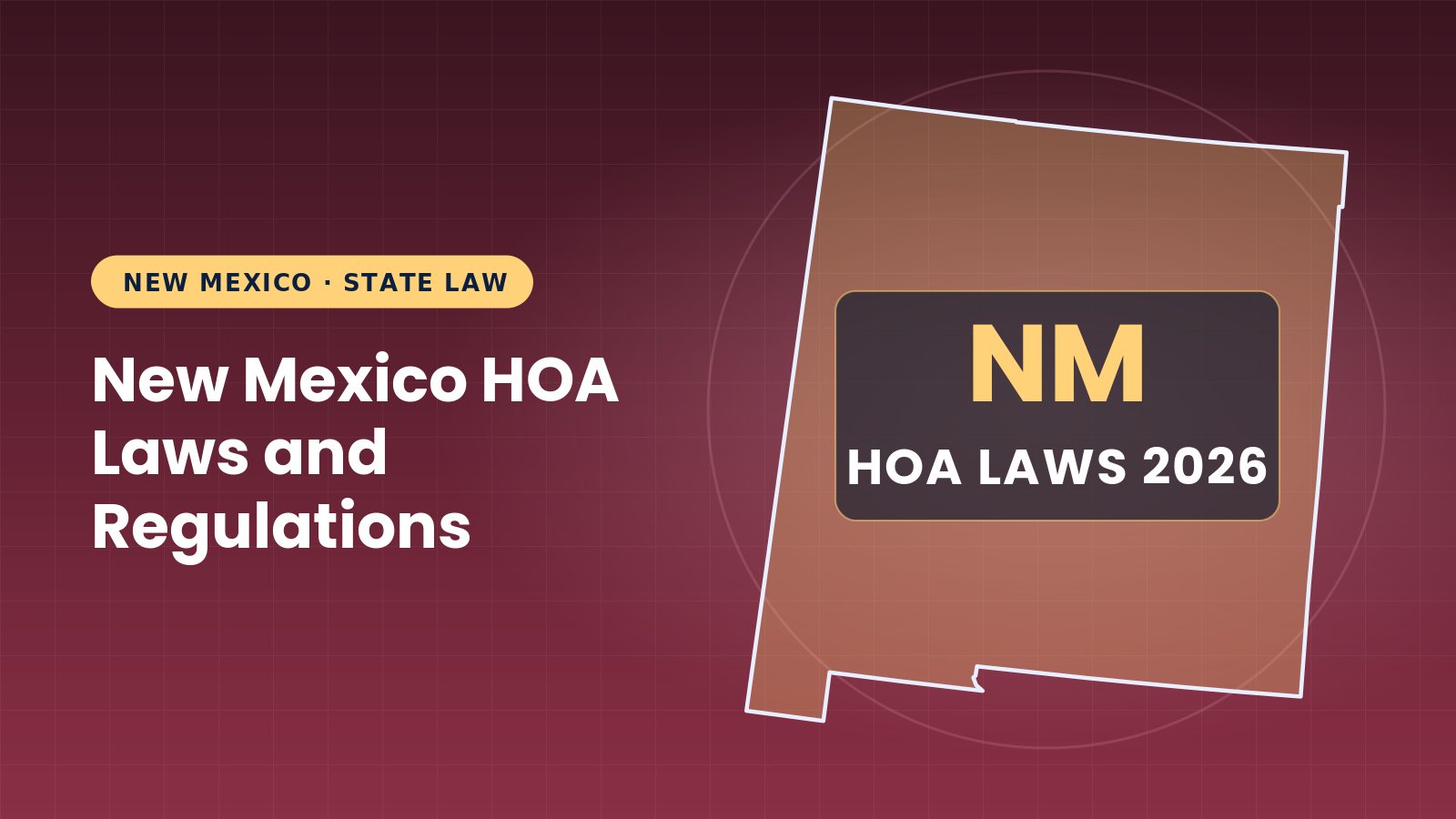
New Mexico regulates homeowner associations through the Homeowner Association Act (NMSA 1978, Sections 47-16-1 to 47-16-18), which covers records, board duties, meetings, voting, audits, fines and dispute resolution. Condominiums are governed separately by the Condominium Act (Sections 47-7A-1 to 47-7D-20). Your declaration, bylaws and rules fill in everything else.
Which laws govern HOAs and condominiums in New Mexico
New Mexico has two main statutes for common interest communities, and the first question for any board is which one applies. Section 47-16-15 says the Homeowner Association Act applies to homeowner associations created and existing in the state, but it does not apply to a condominium governed by the Condominium Act.
- Homeowner Association Act, Sections 47-16-1 through 47-16-18. This is the statute for planned communities and similar lot-owner associations. Its sections address record disclosure (47-16-5), board members and officers (47-16-7), declarant control (47-16-8), proxy and absentee voting (47-16-9), financial audits (47-16-10), disclosure certificates and sale of lots (47-16-11 through 47-16-13), attorney fees (47-16-14), flags (47-16-16), association meetings (47-16-17) and enforcement and dispute resolution (47-16-18).
- Condominium Act, Sections 47-7A-1 through 47-7D-20. Article 7C covers management, including the unit owners association, the executive board, meetings, quorums, voting, insurance, assessments for common expenses (47-7C-15), the lien for assessments (47-7C-16) and association records (47-7C-18).
- Nonprofit Corporation Act, Chapter 53, Article 8. Many associations are incorporated as nonprofits, and Section 47-16-7 itself refers to this Act for associations organized under it.
- Governing documents. The declaration, bylaws, articles and rules control assessments, use restrictions and most day-to-day operations, subject to the statutes above. See our overview of HOA governing documents.
Section 47-16-15 also carves out some provisions for older, smaller associations: Sections 47-16-9, 47-16-10 and 47-16-14 do not apply to associations created before July 1, 2013 that have fewer than thirty lots. Always confirm when your association was created and how many lots it has.
Key HOA rules in New Mexico at a glance
| Topic | What the law says |
|---|---|
| Assessments and liens | Condominiums: the association has a lien for assessments and fines from the time they become due, enforceable like a mortgage, and the lien is extinguished unless enforcement starts within three years (47-7C-16). Homeowner associations: the Homeowner Association Act sections we reviewed do not set out a lien; see your declaration. |
| Records access | Owners may examine financial and other records during regular business hours within ten business days of a written request. No fee for review; copies capped at ten cents per page (47-16-5). |
| Meetings and voting | Annual meeting at least once every thirteen months; notice 10 to 50 days ahead; board meeting notice at least 48 hours ahead; owners may attend and speak at open meetings (47-16-17). Proxy and absentee voting is addressed in 47-16-9. |
| Reserves | We did not verify a statutory reserve funding requirement for homeowner associations; see your documents and budget. |
| Fines and enforcement | Written notice and an opportunity to dispute, plus a hearing or written statement with fourteen days notice before a fine or suspension, unless community documents provide otherwise (47-16-18). |
| Rental restrictions | The Homeowner Association Act sections we reviewed do not set rental caps; see your documents. |
| Architectural review | Not set by the Act sections we reviewed; see your documents. Section 47-16-16 separately addresses flags. |
| Board duties | Appointed-by-declarant directors owe fiduciary care and loyalty; elected directors owe ordinary and reasonable care free from undisclosed conflicts. Directors must certify in writing within ninety days that they have read the community documents (47-16-7). |
Records, meetings and budgets in more detail
New Mexico gives owners unusually concrete transparency rights. Under Section 47-16-5, the records an owner may request include the declaration, bylaws, member names and addresses, five years of non-executive-session minutes, the current operating budget, current assessments, financial statements and bank statements, the most recent audit or review, current contracts and insurance policies. If the association fails to provide access within ten business days, the statute creates a rebuttable presumption of willful noncompliance, and the owner may recover the greater of actual damages or fifty dollars per calendar day starting on the eleventh business day.
Section 47-16-17 limits closed sessions to legal advice from an attorney, pending or contemplated litigation, and personal, health or financial information about an individual member, employee or contractor. Associations must keep written minutes with summaries of agenda items and formal actions.
On finances, Section 47-16-7 requires the board or the owners, as the documents provide, to adopt a budget annually and give each owner a copy within thirty calendar days of adoption, along with a statement listing fees and fines that the association or its management company may charge. Section 47-16-10 requires a financial audit, review or compilation by an independent CPA at least every three years, made available to owners within thirty calendar days of completion. Management contracts must disclose conflicts of interest and list all fees charged to the association or owners (47-16-7).
For practical guidance on board roles, see HOA board member responsibilities, and for enforcement practice see our HOA violations and enforcement guide.
New communities and resales
Newer developments are shaped by Section 47-16-8, which deals with declarant control of the board. According to an annotation citing a New Mexico Attorney General advisory letter (2021-05), the declarant control period ends no later than the earlier of specified conditions, and the share of board seats elected by lot owners increases as more lots are conveyed, with a twenty-five percent threshold referenced in Section 47-16-8(E). Boards and buyers in new communities should read the section itself with counsel.
Sections 47-16-11 through 47-16-13 address contract disclosure statements, disclosure certificates on the sale of lots, and a purchaser right to cancel a purchase contract. Section 47-16-7 also requires the annual fee-and-fine statement to list charges for a disclosure certificate, so resale paperwork fees should be disclosed up front. Check the current text for deadlines and amounts before relying on them.
Recent changes
Much of the current operating framework, including the record-access penalties, board member certification, triennial audit and the meetings and enforcement sections, came from 2019 amendments to the Homeowner Association Act that took effect July 1, 2019. We track later developments in New Mexico HOA law changes 2021-2025.
Remote HOA management in New Mexico
Remote management works well for New Mexico associations because the core work is administrative: collecting assessments, tracking violations, keeping records, preparing budgets and supporting the board. A cloud dashboard gives directors and owners access to financials and documents, online dues collection reduces delinquencies and paper handling, and digital violation tracking creates the written notice trail that Section 47-16-18 contemplates. Board support runs by phone, email and video meeting. Learn more about remote HOA management in New Mexico or see pricing.
Rules on manager licensing and registration vary by state, so associations should confirm what applies in New Mexico before signing a management agreement. We did not verify a New Mexico community association manager licensing requirement for this guide, and a New Mexico attorney or the state licensing agency can confirm. Whatever the licensing status, a contract must satisfy the disclosure requirements of Section 47-16-7.
Frequently Asked Questions
Is there a single New Mexico HOA law?
Yes for homeowner associations: the Homeowner Association Act, Sections 47-16-1 to 47-16-18. Condominiums are under the separate Condominium Act, and the declaration and bylaws also govern.
How fast must an HOA produce records in New Mexico?
Within ten business days of a written request under Section 47-16-5. Late production creates a rebuttable presumption of willful noncompliance and potential damages of at least fifty dollars per day.
Can a New Mexico HOA fine me without a hearing?
Generally no. Section 47-16-18 requires written notice and an opportunity for a hearing or written statement, with fourteen days notice of the hearing, except for violations posing an imminent threat to public health or safety.
How often must a New Mexico HOA hold meetings and audits?
An annual meeting at least every thirteen months (47-16-17) and a financial audit, review or compilation at least every three years (47-16-10), subject to the exemption for some older, small associations in 47-16-15.
Can an HOA record a lien for unpaid assessments in New Mexico?
Condominium associations have a statutory lien under Section 47-7C-16. For homeowner associations, lien rights typically come from the recorded declaration, so review yours with an attorney before pursuing collection. See also what powers an HOA has.
How APM Helps
Association Property Managers supports boards across the country with remote HOA and condo management, from accounting and collections to violation tracking and meeting support. Explore our association management services or request a free proposal; we respond within 3 business days. New to the topic? Read what is HOA management.
This article is general information, not legal advice. Laws change and associations differ; consult a licensed attorney in New Mexico. Last verified October 25, 2026.
Ready to work with Association Property Managers?
Get a free, itemized proposal for your community — delivered within 3 business days.
Request a Free Proposal