The Short Answer
HOA fees fund two categories of expenses: operating expenses (the day-to-day cost of running the community) and reserve contributions (money set aside for future capital replacements). Understanding how your fees are allocated helps you evaluate whether they are reasonable and where the money goes.
Operating Expenses: Where the Monthly Money Goes
Common area maintenance and landscaping
For most HOAs, landscaping is the largest single operating expense — mowing, trimming, irrigation maintenance, seasonal plantings, and tree care. In communities with extensive common areas, landscaping can consume 30–50% of the operating budget.
Professional management fees
If the community uses a professional management company, the management fee is typically a significant line item. Full-service management fees range from $8 to $30 per unit per month depending on the level of service and community size.
Utilities for common areas
Electricity for common area lighting, water for irrigation, and natural gas for common area facilities are typically HOA expenses.
Insurance
The association's property and liability insurance premiums are operating expenses. In recent years, insurance costs have increased significantly in many markets — sometimes 20–40% annually — making insurance one of the fastest-growing HOA expense categories.
Common area repairs and maintenance
Routine repairs to pool equipment, parking lot surfaces, fencing, irrigation systems, and common buildings are operating expenses. The line between operating maintenance and capital replacement is important — larger-scale replacements belong in the reserve fund.
Administrative costs
Management software, legal fees, accounting fees, postage, and other administrative costs are typically a smaller but necessary part of the operating budget.
Reserve Contributions: Saving for the Future
Reserves are funds set aside specifically for future capital replacements — the large, predictable expenses that occur every 10 to 30 years:
- Roof replacement on common area buildings
- Pool resurfacing and equipment replacement
- Parking lot repaving
- Fence replacement
- Clubhouse HVAC systems
- Exterior painting of common area buildings
A well-funded reserve is the difference between a community that handles major repairs smoothly and one that levies large, unexpected special assessments.
How to Evaluate Whether Your HOA Fees Are Reasonable
Compare your community's per-unit monthly fee to similar communities in your area. HOA fees vary dramatically based on: community size, amenity level, common area square footage, and geographic market. A $200/month fee for a community with a clubhouse, pool, and extensive landscaping may be very reasonable; the same fee for a community with only a small sign at the entrance is probably not.
Ask for a budget breakdown. Every homeowner has the right to receive the budget. Review it line by line: Does the landscaping cost seem in line with what you see? Is management company fee reasonable for the services provided? Is the reserve contribution at the level recommended by the reserve study?
Frequently Asked Questions
Can the HOA raise fees without homeowner approval?
In most HOAs, the board can increase annual dues up to a percentage cap specified in the governing documents (often 10–20%) without a homeowner vote. Increases above the cap typically require a member vote. Check your CC&Rs.
Are HOA fees tax deductible?
For homeowners using the property as a primary or secondary residence, HOA fees are generally not tax deductible. For rental property owners, HOA fees may be deductible as a rental property expense. Consult a tax professional.
What happens if I don't pay my HOA fees?
Non-payment triggers late fees, collections actions, a lien on your property, and potentially foreclosure. HOA dues are a legal obligation, not an optional charge.
How APM Keeps Fees Reasonable and Transparent
Association Property Managers helps communities get the most out of every dollar in their operating budget. Competitive bidding on major vendor contracts, real-time budget-versus-actual tracking through the HOA Alchemy live bank dashboard, and a vendor invoice approval workflow that catches errors before payment all contribute to financial discipline.
APM provides every board with a live view of where fees are going — not a once-a-year summary. For Bay Area communities, APM's smart irrigation remote control cuts water bills by 25-35%, directly reducing one of the largest line items in the operating budget.
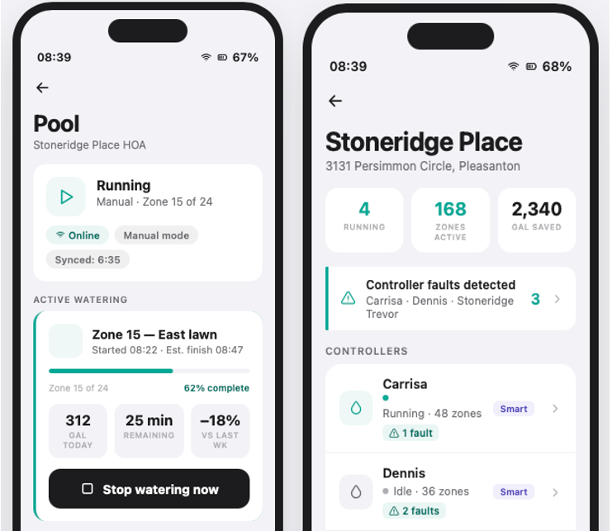
HOA Alchemy smart irrigation controls — real zones, real properties, managed remotely. This is the actual platform APM uses to cut Bay Area water bills 25–35%.
For a proposal that shows exactly what APM fees include, contact billing@apmhoa.com or visit apmhoa.com.
Ready to work with Association Property Managers?
Get a free, itemized proposal for your community — delivered within 3 business days.
Request a Free Proposal