# Why Bay Area HOA Boards Are Leaving Big Management Firms
Something is shifting in Bay Area HOA management. Boards that have been with large national management companies for years — sometimes decades — are switching. Not because something catastrophic happened, but because a better alternative now exists.
In the last few years we've spoken with dozens of Bay Area HOA boards evaluating their management arrangements. The complaints are remarkably consistent, regardless of which large company the board is describing. This post documents the five reasons we hear most often.
---
Reason 1: Boards Feel Like They're Governing in the Dark
The standard large-company model: your community manager handles the day-to-day, and the board gets a monthly PDF report. Sometimes the report arrives on time. Sometimes it's two weeks late. The bank balance the board sees in January is the December 31 balance — a snapshot from 30 to 45 days ago.
Meanwhile, vendors are being paid. Emails are being sent to homeowners. Service requests are being closed. And the board has no visibility into any of it in real time.
One Bay Area board treasurer described it this way: "We had a vendor dispute where a pool contractor billed us for three visits in October. We had no way to verify. We knew we'd paid them — we could see the check in the monthly report — but whether they actually came out three times? We had to trust the manager, and the manager was trusting the vendor."
The hunger for real-time transparency — for a board dashboard that shows what's happening today, not what happened last month — is the single most common reason boards tell us they start looking for alternatives.
---
Reason 2: Manager Turnover Erases Community Knowledge
Large management companies manage large portfolios, and they staff them with community managers who often carry 20–40 communities each. When those managers leave — which happens frequently in the industry — the institutional knowledge leaves with them.
Bay Area boards describe the pattern: a new manager arrives, spends the first few months trying to get up to speed on governing documents, vendor relationships, and homeowner history, and then either leaves again or gradually settles in. In the meantime, the board picks up the slack.
The compounding effect of repeated manager turnover is one of the most underappreciated costs in HOA management. The board spends time re-educating managers. Vendors who built relationships with the previous manager may not perform as reliably for the new one. Homeowners who trusted the previous manager's communication style become skeptical of the new approach.
A management company that assigns a dedicated manager (with genuine backup coverage, not a promise) and keeps that manager in place makes the board more effective — not less.
---
Reason 3: Technology Promises That Don't Match Reality
Large HOA management companies have invested in proprietary software platforms. These platforms handle resident portals, payment processing, work orders, and financial reporting. They're functional. They're also built to serve the management company's operational needs at scale, not to maximize board transparency or homeowner experience.
Common board complaints about large-company platforms:
- **Delayed data.** Financial dashboards show yesterday's data or last month's data, not live bank balances.
- **Limited board access.** Board members can view documents and financials but cannot see communication logs, call recordings, or text message history.
- **No vendor accountability features.** Work orders are created and closed in the system, but there's no GPS verification, no before/after photos tied to the job, no time-on-site tracking.
- **Separate tools for everything.** Irrigation control, access management, camera alerts, and environmental sensors are handled by completely separate vendors with separate contracts and separate logins.
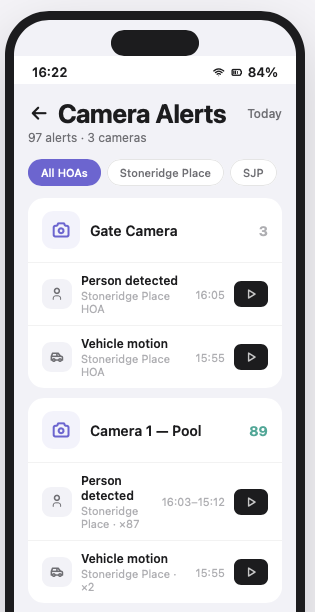
Real-time camera alerts inside the HOA Alchemy app — gate and pool cameras, person and vehicle detection, all in one place. No separate app, no separate login.
Bay Area boards are increasingly aware that the technology gap between what large management companies offer and what's actually available in purpose-built modern management platforms is significant — and growing.
---
Reason 4: Pricing Opacity and Fee Creep
Ask any large Bay Area management company what HOA management costs. Most will say "it depends" and ask you to submit a request for proposal before they'll give you a number.
Once you get the proposal, you get a per-door rate and a schedule of "additional services" that can be surprisingly long. Fees for additional meetings. Fees for special assessments. Project management percentages on capital work. Resale package fees. After-hours surcharges.
A board in Fremont described their experience after three years with a large national company: "Our contract was $24 per door per month. Seemed reasonable. When we actually tallied up everything we paid — the base fee, the project management fees on the pool deck work, the assessment fees, the extra meeting charges — we were paying the equivalent of $38 per door when you spread it out annually. That's a very different number."
Fee creep is not unique to any single large company. It's a structural feature of an industry that competes on headline per-door rates while recovering margin through ancillary fees. Boards that understand the full fee schedule before signing — and that get itemized proposals rather than just per-door rates — are better positioned to make accurate cost comparisons.
---
Reason 5: A Feeling That Residents Are Just Accounts
This one is harder to quantify, but boards mention it often: the sense that at a large national management company, the community is a client account, homeowners are occupants, and the relationship is fundamentally transactional.
This feeling tends to crystallize around specific incidents. A homeowner calls with an urgent maintenance issue and reaches a 1-800 call center that cannot answer community-specific questions. A violation notice goes out with the wrong homeowner's address because data was not updated. A special assessment check gets lost in the mail and nobody follows up.
No management company is immune to operational errors. What distinguishes companies is how errors are caught, how they're communicated, and whether the team that manages your community actually knows your community.
---
What Boards Find When They Switch
When Bay Area boards switch from large national management companies to technology-forward alternatives, the most consistent feedback we hear across the transition is:
**Surprise at how much visibility was missing.** When boards can see every email, every call, every text, every service request, and every vendor payment in real time, they often realize how much information they had been operating without.
**Confidence in vendor billing.** GPS-verified invoices tied to photos and time-on-site documentation give boards concrete evidence to support or dispute every payment. Several boards have found historical billing discrepancies during the first 90 days of the transition.
**Faster decisions.** When a board can log into a dashboard and see the current bank balance, the pending vendor invoices, and the open service requests, decision-making at board meetings becomes faster and more confident. Time spent on "what's our balance?" and "did we pay that invoice?" drops to near zero.
**Homeowner reactions.** Boards that share live financial data with residents (with appropriate controls) consistently report that homeowner trust in the board increases. Financial transparency reduces the "what are they doing with our money?" conversations that consume board meeting time.
---
Is Switching Worth It?
The honest answer is: it depends on your community's specific situation. Switching management companies involves real transition work — gathering records, notifying vendors, communicating with homeowners, transferring banking relationships, and bringing a new team up to speed on your community.
For most Bay Area communities, the right conditions for switching are:
1. Your board consistently feels underinformed about community operations
2. Vendor billing disputes have occurred without satisfactory resolution
3. Your all-in annual management cost (base fee + all add-ons) exceeds $35/door/month
4. Manager turnover has happened more than once in the past 3 years
5. Your current platform lacks real-time financial visibility or vendor accountability features
If three or more of these apply, a competitive proposal from a technology-forward management company is worth the time.
[APM offers Bay Area HOA boards a free, itemized proposal](/contact#proposal) with a full 5-year cost comparison against your current management arrangement. No obligation, delivered in 3 business days.
Why APM Is What Bay Area Boards Switch To
APM Management built its model to address precisely the problems boards describe when leaving large management companies. The HOA Alchemy platform provides the real-time financial visibility that eliminates the "what is our balance?" problem. Our GPS-verified vendor program ends unverified invoicing. Our unified messaging system means no communication falls through the cracks. And because every vendor in our network is background-verified — not a gig worker — the quality and accountability standard is consistent.
All vendors are employees or background-verified contractors. Our 98% dues collection rate is documented. Our Bay Area clients include Stoneridge Place at Pleasanton, where homes now sell for 7% more per square foot under APM management.
Make the Switch
APM serves communities in Pleasanton, Dublin, San Ramon, Fremont, and Newark. Contact us at billing@apmhoa.com or visit apmhoa.com for a free itemized proposal with a full 5-year cost comparison.
Ready to work with Association Property Managers?
Get a free, itemized proposal for your community — delivered within 3 business days.
Request a Free Proposal