Quick Answer
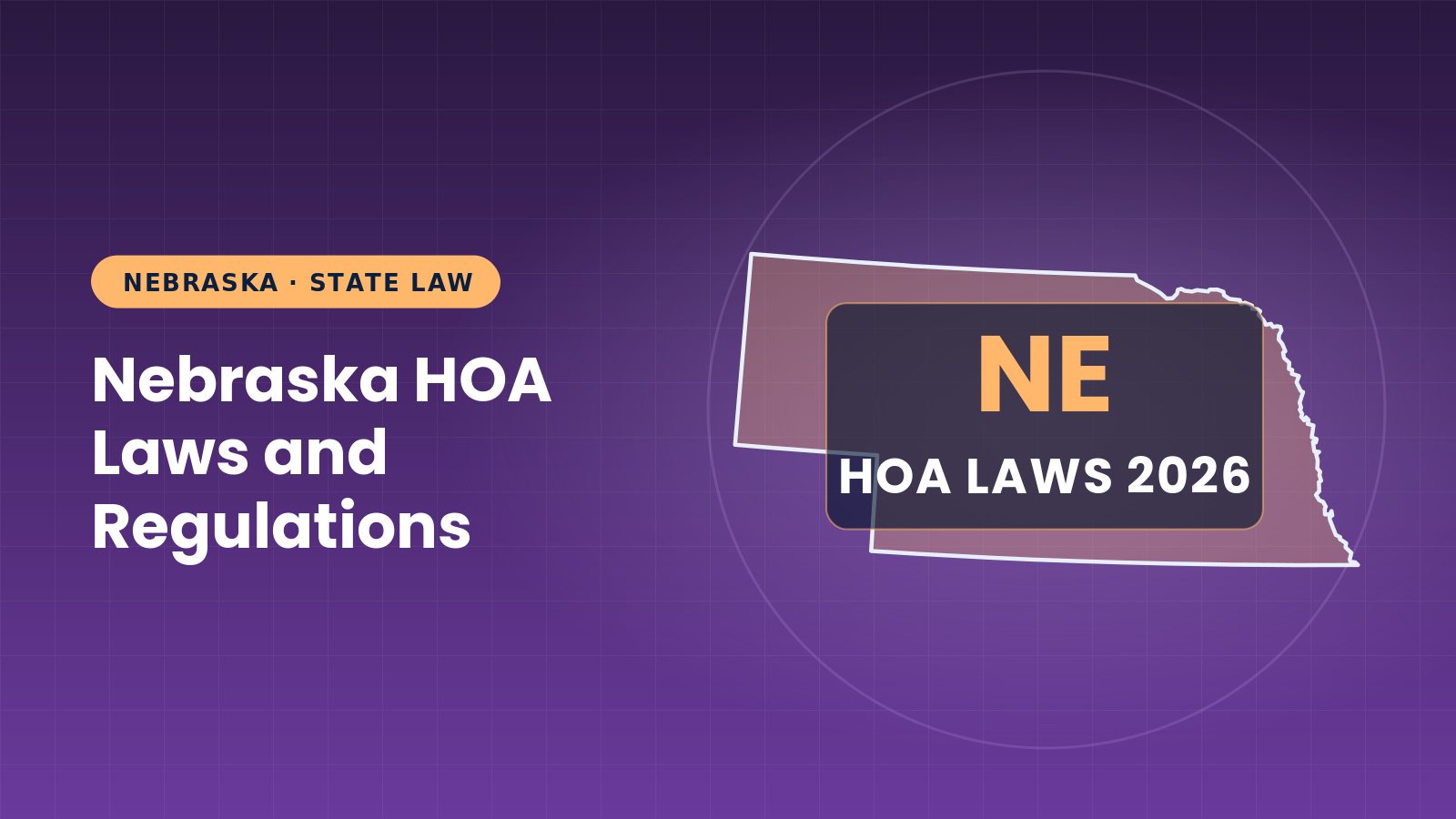
Nebraska has no comprehensive HOA statute. Condominiums created after January 1, 1984 are governed by the Nebraska Condominium Act, sections 76-825 to 76-894. Older condominiums fall partly under the Condominium Property Act, sections 76-801 to 76-823. Other associations rely on their declarations, bylaws, the Nebraska Nonprofit Corporation Act (21-1901 to 21-19,177), and the lien statute at 52-2001.
Which laws govern HOAs and condominiums in Nebraska
Nebraska Condominium Act. Section 76-826 states that the Act applies to all condominiums created in Nebraska after January 1, 1984. For earlier condominiums, listed sections of the Act apply to events after that date, and the provisions of sections 76-801 to 76-824 do not apply to condominiums created after January 1, 1984. Key provisions include 76-860 (association powers), 76-861 (executive board), 76-866 (meetings), 76-873 (assessments), 76-874 (lien for assessments) and 76-876 (association records).
Non-condominium HOAs. Nebraska does not have a general planned-community act that I could identify. A homeowners' association outside a condominium is governed by its recorded declaration or covenants and bylaws, general contract and property law, and, if incorporated, the Nebraska Nonprofit Corporation Act. One statute specifically addresses these associations: section 52-2001 creates a lien for assessments for homeowners' associations, parallel to the condominium lien.
Nonprofit corporation law and conflicts. A Nebraska Court of Appeals decision cited in the annotations to 76-876 explains that the Nonprofit Corporation Act applies broadly to nonprofits while the Condominium Act applies only to condominium regimes, and that the more specific statute controls when they conflict on the same subject. Condominium boards should therefore read both.
For background on how the layers work together, see HOA governing documents explained, how an HOA works, what powers an HOA has and what a condo association is.
Nebraska HOA law at a glance
| Topic | What Nebraska law says (verified) |
|---|---|
| Assessments and liens | Condominiums: 76-873 requires assessments at least annually and provides that past-due assessments bear interest at a rate set by the association not exceeding 18 percent per year. Under 76-874 the association has a lien once the assessment is due and a notice stating the dollar amount is recorded; it is generally prior to other liens except pre-declaration liens, a first mortgage recorded earlier, and tax liens; it is extinguished unless enforcement begins within three years; and the prevailing party recovers costs and reasonable attorney's fees. Section 76-874.01 permits an escrow of up to six months of assessments from purchasers after September 6, 2013. HOAs: 52-2001 provides a similar recorded-notice lien. |
| Records access | Condominiums: 76-876 requires financial records and makes records reasonably available for examination by any unit owner and authorized agents. The statute speaks of examination, and a Court of Appeals decision annotated there held it does not by itself give a right to make copies. Other associations: see your documents and the Nonprofit Corporation Act. |
| Meetings and elections/voting | Condominiums: 76-866 requires a meeting at least once a year. Special meetings may be called by the president, a majority of the board or owners holding 20 percent of the votes, or any lower percentage in the bylaws. Notice must be delivered not less than 10 nor more than 50 days ahead and state the agenda. Quorum and voting are addressed in 76-867 and 76-868. |
| Reserves | Condominium associations may adopt budgets for revenue, expenditures and reserves under 76-860(a)(2). I did not identify a statute that mandates a specific reserve level; see your documents. |
| Fines and enforcement | Condominiums: 76-860(a)(11) allows reasonable fines for violations of the declaration, bylaws and rules after notice and opportunity to be heard, and late charges. HOAs: see your documents. |
| Rental restrictions | See your documents. |
| Architectural review | See your documents. |
| Board duties | Under 76-861(a), condominium board members and officers are required to exercise ordinary and reasonable care. Under 76-861(b) and 76-860(a)(4), litigation for owners is subject to limits, including an 80 percent vote for certain suits. |
This summary omits conditions and exceptions in each section. See also HOA reserve funds explained, the violations and enforcement guide, board member responsibilities and HOA rental caps.
Budget ratification
Nebraska condominiums use a ratification model. Under 76-861(c), within thirty days after adopting a proposed budget the board must send owners a summary and set a meeting for ratification not less than fourteen nor more than thirty days after mailing. The budget is ratified unless a majority of all votes in the association, or any larger vote specified in the declaration, reject it. If rejected, the last ratified budget continues.
Collections and liens
Because lien rights are statutory, notice and recording steps matter. A board should confirm that a lien notice is recorded where mortgages are recorded, that lienholders receive reasonable notice before foreclosure, and that the three-year enforcement window is tracked. Unit owners may request a recordable statement of unpaid assessments, which a condominium association must provide within ten business days under 76-874(g). Associations should have counsel review collection policies.
Fines and enforcement for non-condominium HOAs
For communities outside the Condominium Act, authority to fine usually comes from the declaration and bylaws. Boards should follow the procedure written there, give written notice, offer a hearing, and apply rules evenhandedly. Our violations guide describes common practice.
Recent changes
Most of the sections reviewed for this guide were enacted decades ago, with notable amendments in 2013 (LB 442), which added the escrow provision at 76-874.01 and amended the lien statute. The Nebraska Legislature regularly considers bills affecting associations. Our running summary is in Nebraska HOA law changes 2021-2025. Always check the current statute text or ask counsel before relying on a summary.
Remote HOA management in Nebraska
Most day-to-day association work does not require a manager to be on site. With remote management, the board and owners use a cloud dashboard for financial reports, budgets, work orders and governing documents; owners pay dues online; violations are logged and tracked digitally with notices and photos; and the board reaches the management team by phone, email or video for meetings and decisions. Vendors can still be coordinated locally, and site visits can be scheduled when a board wants them. Learn more about remote HOA management in Nebraska or review our pricing.
Nebraska associations can use remote management for financials, assessment collection, communications and board support while still using local vendors for maintenance. I did not find a Nebraska license specific to community association managers in my review, but I did not verify whether the Nebraska Real Estate License Act or other rules reach any management activities, so rules on manager licensing and registration vary by state and associations should confirm what applies in Nebraska, for example with the Nebraska Real Estate Commission or counsel, before hiring.
Frequently Asked Questions
Does Nebraska have an HOA statute?
Not a comprehensive one that I could identify. Condominiums are governed by the Nebraska Condominium Act, sections 76-825 to 76-894, and homeowners' associations rely on governing documents, nonprofit corporation law if incorporated, and the lien statute at 52-2001.
Can a Nebraska HOA place a lien on my home?
Yes, if it follows the statute. Sections 76-874 (condominiums) and 52-2001 (homeowners' associations) provide for a lien after the assessment is due and a notice with the dollar amount is recorded, and foreclosure is generally handled like a mortgage. Enforcement must start within three years.
How much interest can a condo association charge on late assessments?
Under 76-873, past-due assessments bear interest at a rate the association sets, not exceeding 18 percent per year, subject to the declaration. Late charges are authorized separately under 76-860(a)(11).
Can a Nebraska condo association fine owners?
Section 76-860(a)(11) allows reasonable fines for violations of the declaration, bylaws and rules after notice and an opportunity to be heard. Check your documents for the specific procedure and amounts.
How do owners vote on the budget in a Nebraska condo?
Under 76-861(c), the board mails a summary and holds a ratification meeting. The budget is ratified unless a majority of all votes in the association, or a larger vote the declaration specifies, rejects it.
How APM Helps
Association Property Managers (APM) provides HOA and condominium management from offices in East Lansing, Michigan and Dublin, California, and offers remote management to boards nationwide. Our association management services cover financials, assessment collection, vendor coordination, violation tracking and board support. To see what fits your community, request a free proposal; we return proposals within 3 business days. You can also call 810.777.7060.
This article is general information, not legal advice. Laws change and associations differ; consult a licensed attorney in Nebraska. Last verified October 25, 2026.
Ready to work with Association Property Managers?
Get a free, itemized proposal for your community — delivered within 3 business days.
Request a Free Proposal